Key Summary
- Samsung Electronics' support results: 46% productivity, 54% defect reduction
- Turning results into measurable process metrics
- Deciding who operates the system after support ends
- This week: Check whether process metrics are being recorded
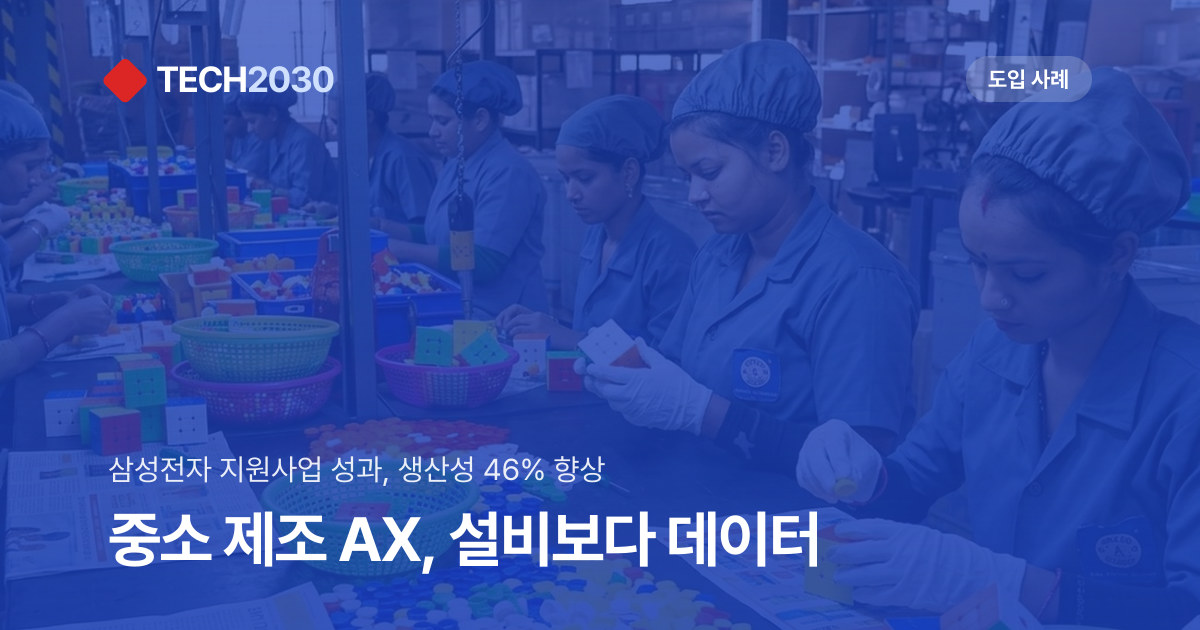
The smart factory support program results that Samsung Electronics disclosed, based on data from the Korea Federation of SMEs, showed a 46% improvement in productivity and a 54% improvement in defect rates. Regardless of business relationships, Samsung Electronics supports small and medium-sized enterprises (SMEs) and mid-sized companies in building smart factories, sending manufacturing experts on-site to diagnose process issues and assist with quality control and workforce training. In 2026, the company expanded its support scope to 'Smart Factory 4.0,' which incorporates manufacturing AI.
Why Automation Is Difficult for Small Manufacturers
According to the 'World Robotics Report 2026' released by the International Federation of Robotics (IFR) in September 2026, South Korea installed approximately 30,000 new industrial robots in 2025, ranking fourth globally. Robots were primarily adopted in factories with large-scale production facilities, mainly in the electronics and automotive industries. While large corporations expand robotics and AI in their production processes, small and medium-sized manufacturers struggle to purchase equipment and secure specialized personnel.
- EquipmentIt is difficult to apply a large corporation's equipment and operating systems as-is to smaller partner companies that differ in production scale and processes.
- WorkforceAccording to statistics released by the Korea SMEs and Startups Institute in March 2026, the proportion of workers aged 50 and older is higher at SMEs than at large corporations. While technology is needed to reduce repetitive tasks while leveraging the experience of skilled workers, there is also a shortage of specialized personnel to operate such technology.
- CostAccording to a survey by the Ministry of SMEs and Startups, the average cost of smart factory adoption for SMEs was 750 million won. After adoption, companies must also cover maintenance and operating costs, but many SMEs lack even a dedicated team to manage this.
What Changes When Prime Contractors and Partners Work Together
- LG ElectronicsA refrigerator parts supplier adopted an AI vision inspection system, reducing production status management time by 75%.
- POSCODaechun, a shipbuilding parts company supported by POSCO, cut shipping time by 23% through automated warehouse management.
- Shipbuilding M.AX AllianceLaunched in an expanded form on October 12, 2026, by the Ministry of Trade, Industry and Energy and the Ministry of Oceans and Fisheries. Within this alliance, HD Hyundai Samho and Daea Industry plan to verify AI transformation (AX) technology for block assembly processes and expand it to other partner companies.
What Should Remain After Support Ends
The key question is whether companies can manage their equipment independently after the support program ends. In a December 2025 report, researchers at the Korea SMEs and Startups Institute proposed continued support for cloud usage fees and maintenance costs after implementation, along with strengthened on-site training.
Professor Kim Yong-jin of Sogang University's School of Business pointed out that building systems individually for each company makes continuous operation and advancement difficult. He emphasized, "Since it's far more important to collect data and manage operations around it, companies should jointly use cloud and data resources by region or industry. It makes more sense to first build a structure for accumulating and effectively utilizing data, and then introduce automation equipment and physical AI."
Kim Yoo-bin, a senior research fellow at the Korea Labor Institute, said, "For some small, labor-intensive businesses, maintaining manual work may actually be more advantageous. Since the profitability of automation investment varies by product, process, and company size, support methods should be tailored to individual SMEs."
Implications for Korean Enterprise AX
The results disclosed in the Samsung Electronics, LG Electronics, and POSCO cases were presented using process-based metrics such as productivity, defect rate, management time, and shipping time. For small manufacturers considering AX, the right sequence is to first determine which process and which metric to improve, rather than which equipment to purchase. As senior research fellow Kim Yoo-bin noted, since the profitability of automation varies by product, process, and scale, companies need a way to evaluate the automation decision itself using that same metric.
Considering the average implementation cost of 750 million won alongside ongoing maintenance and operating costs, the real criterion for judgment is not the point of implementation but what happens after support ends. Companies considering adoption should first determine who will manage the equipment and data after the support program concludes, and who will cover cloud usage fees and maintenance costs.
There is one thing worth checking in your own organization this week: verify whether metrics such as productivity, defect rate, and shipping time for the process you want to improve are currently being recorded as data. If they are not, establishing that recording system first—before investing in automation equipment—aligns with the sequence Professor Kim Yong-jin described.
Source: Sharing Know-How Between Large Corporations and SMEs Boosted Productivity by 46%